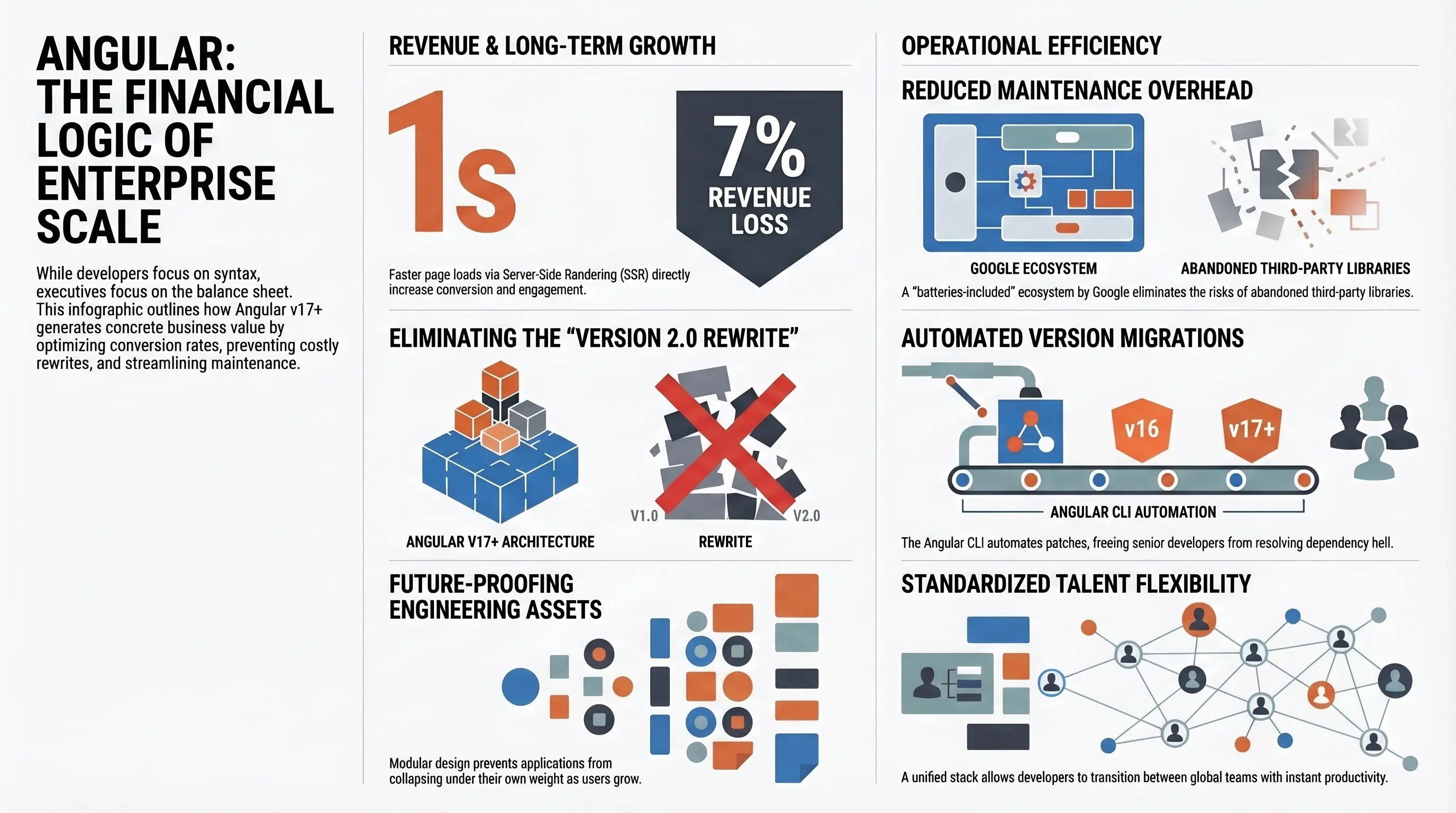
When executives and stakeholders look at software, they don't see code-they see operational costs, conversion rates, and time-to-market. While developers often debate over frameworks based on syntax or developer experience, the real battle is won on the balance sheet.
Angular, particularly in its modern Renaissance era (v17+ featuring Signals and standalone components), is uniquely positioned to deliver tremendous financial return on investment (ROI). Here is how fast, scalable Angular applications generate concrete business value.
1. Speed Equals Revenue (Conversion Rates)
It is a proven industry standard: a one-second delay in page load time can reduce conversions by up to 7%. For enterprise e-commerce platforms or SaaS tools, that translates to millions of dollars in lost revenue annually.
Modern Angular provides out-of-the-box solutions that drastically improve Time to Interactive (TTI) and First Contentful Paint (FCP). With Server-Side Rendering (SSR), Hydration, and the blazing-fast esbuild bundler, Angular delivers fully rendered UI directly to the user's browser, eliminating white screens of death.
Faster applications mean users stay engaged, bounce rates drop, and checkout processes are completed.
2. Scalability Means Future-Proofing
A prototype built over a weekend in a trendy library might look great on day one. But what happens on day 500, when your user base has grown by 10,000%, and your team has expanded from 2 to 40 developers?
Many applications collapse under their own weight, forcing companies into an expensive "Version 2.0 Rewrite" that paralyzes new product features for a year. Angular prevents this. Its strictly opinionated architecture, robust Dependency Injection (DI) system, and modular nature mean that adding the 100th feature is exactly as safe and predictable as adding the first.
Scalability guarantees that your initial engineering investment is retained, saving you the catastrophic cost of legacy rewrites.
️ 3. Reducing Maintenance Overhead
The true cost of software isn't writing it-it is maintaining it. In many stacks, "JavaScript fatigue" forces teams to constantly rewrite code simply because a third-party router or state-manager library was abandoned by its creator.
Angular is backed by Google. It is a "batteries-included" ecosystem where the router, forms, HTTP client, and testing utilities are all maintained under the exact same roof, on the same release cycle.
Furthermore, the legendary ng update CLI tool automates migrations between major versions. A framework that patches itself drastically reduces the maintenance hours you must pay for, freeing your senior developers to work on features rather than resolving dependency hell.
4. Talent Acquisition and Team Flexibility
When you run an enterprise business, you need developers who can seamlessly transition between projects. If Team A builds their app with one set of random libraries, and Team B builds theirs with another, cross-team collaboration becomes impossible.
Angular standardizes the entire frontend layer. An Angular developer hired in Berlin can sit down at a desk in New York, instantly understand the architecture of your internal CRM project, and commit highly productive code on day one. Unifying your stack under Angular massively de-risks your hiring process.
Conclusion
Choosing Angular isn't just a technical decision; it is a financial strategy. By prioritizing performance to secure conversions, enforcing strict architecture to avoid rewrite bankruptcies, and automating maintenance to reduce overhead, fast and scalable Angular applications are one of the most reliable investments a modern enterprise can make.