"It works perfectly on my machine!"
Every developer has said this at least once. But as your team scales, your codebase grows, and your user base expands, hoping that code works "perfectly" is no longer a viable strategy. You need guarantees. This is where unit testing comes in.
Many teams view unit testing as a luxury - something that slows them down when deadlines are tight. In reality, unit testing is the only way to move fast without breaking things in the long run. Here is why unit testing is a mandatory step for long-term project stability.
️ Regression Safety: The Freedom to Refactor
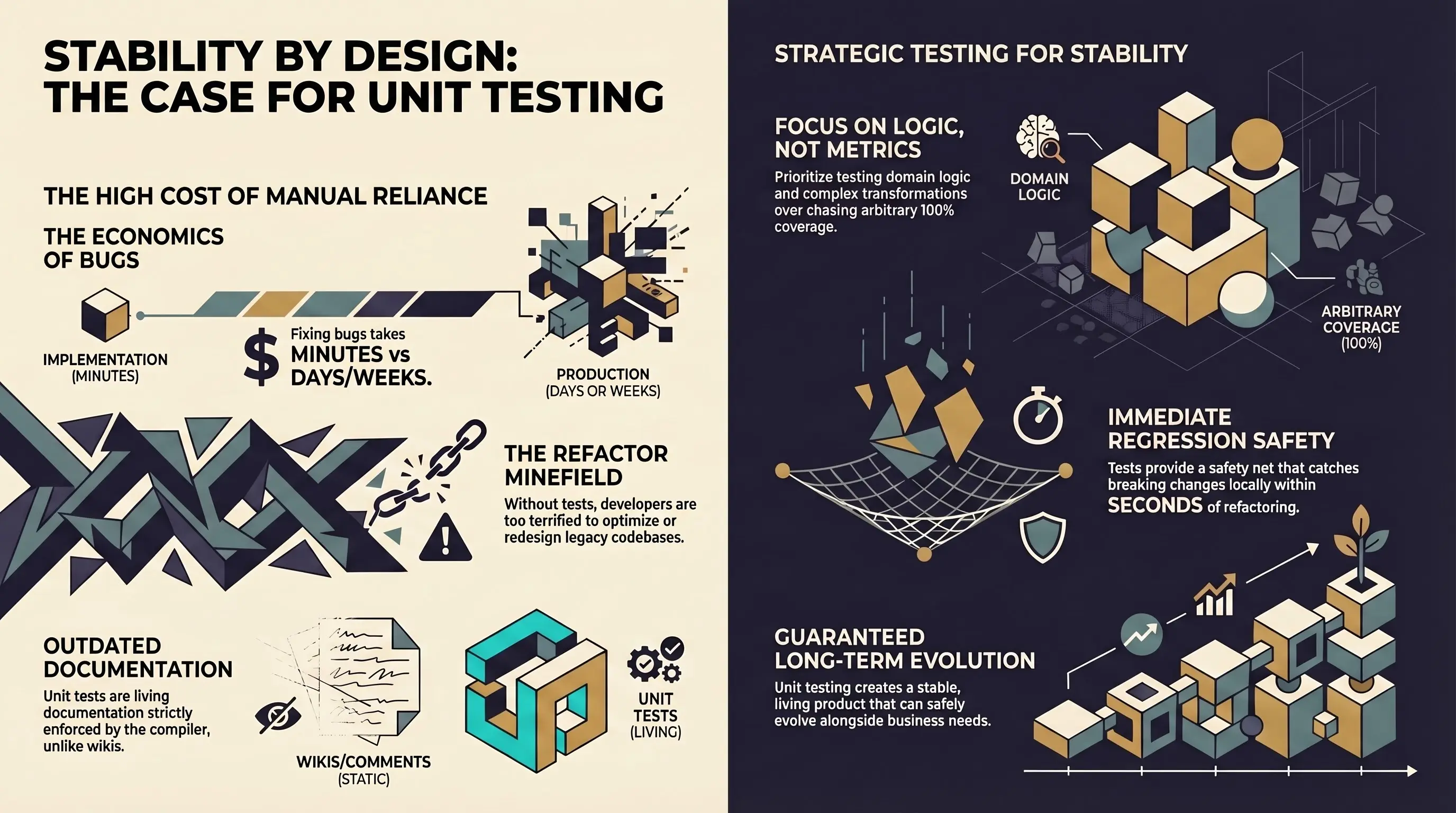
Imagine you are tasked with optimizing a core algorithm written by a developer who left the company two years ago. Without tests, every change you make feels like walking through a minefield. You change one line, check the app in your browser, and pray you didn't break an obscure edge case.
With a comprehensive suite of unit tests, you have a safety net. You can mercilessly refactor, optimize, and redesign your code. If you break existing functionality (a regression), your tests will fail locally within seconds, long before the code reaches production.
Executable Documentation
Comments get outdated. Wiki pages are ignored. Jira tickets are lost in the void.
Unit tests, on the other hand, are documentation that actually executes. If you want to understand what a class does, read its tests. They explicitly detail the expected behavior of the code under various scenarios.
import { Calculator } from './calculator';

describe('Calculator', () => {
  it('should add two positive numbers correctly', () => {
    // Arrange
    const calculator = new Calculator();

    // Act
    const result = calculator.add(2, 3);

    // Assert
    expect(result).toBe(5);
  });
});
If the logic changes, the test must change, meaning this "documentation" is always up-to-date and strictly enforced by the compiler and your CI/CD pipeline.
The Economics of Bugs
Finding and fixing a bug while you are actively writing the code takes minutes.
Finding and fixing that same bug after it has been merged, deployed to staging, reported by QA, triaged by a project manager, and assigned back to you two weeks later? That takes hours or even days.
Worse, if a bug makes it to production, it causes data corruption, user frustration, and reputational damage.
// It's easy to break this without noticing if you don't have tests
function calculateDiscount(price: number, isPremium: boolean): number {
  // Wait, did we mean > or >= for premium tier?
  if (isPremium && price >= 100) {
    return price * 0.8;
  }
  return price;
}
Unit testing forces developers to think deeply about edge cases (like the discount logic above) during the implementation phase, drastically reducing the number of defects that make it downstream. The time invested in testing pays for itself ten times over by reducing debugging cycles.
You Don't Need 100% Coverage
The biggest mistake teams make is chasing 100% code coverage. This leads to testing trivial getters and setters, writing fragile tests, and ultimately burning out developers.
Focus on testing your domain logic. Prioritize utilities, complex data transformations, state management, and edge cases. If a piece of code calculates prices, authenticates users, or formats data, it must be tested. Leave visual layout and E2E checks to Cypress or Playwright.
Conclusion
Writing unit tests takes time, but it is an investment in your project's future. It is the difference between a legacy codebase that developers are terrified to touch, and a stable, living product that can safely evolve alongside your business.
If you want to build for the long term, unit tests are not optional.