When starting a new project, developers are often lured by the hottest UI libraries and the promise of ultimate flexibility. However, when building enterprise software, technology choices aren't just about developer experience - they are about business longevity, risk mitigation, and team scalability.
For enterprise solutions, you don't just need a UI library. You need a complete framework.
Here is why Angular remains the undefeated champion for large-scale, enterprise-level web applications.
Batteries Included (Opinionated by Design)
In the React ecosystem, starting a project means answering a dozen architectural questions before writing the first feature:
- Which router should we use? (React Router, TanStack Router, Wouter?)
- How do we handle forms? (React Hook Form, Formik?)
- What about state management? (Redux, Zustand, Jotai, MobX?)
- How do we handle HTTP calls? (Axios, Fetch, React Query?)
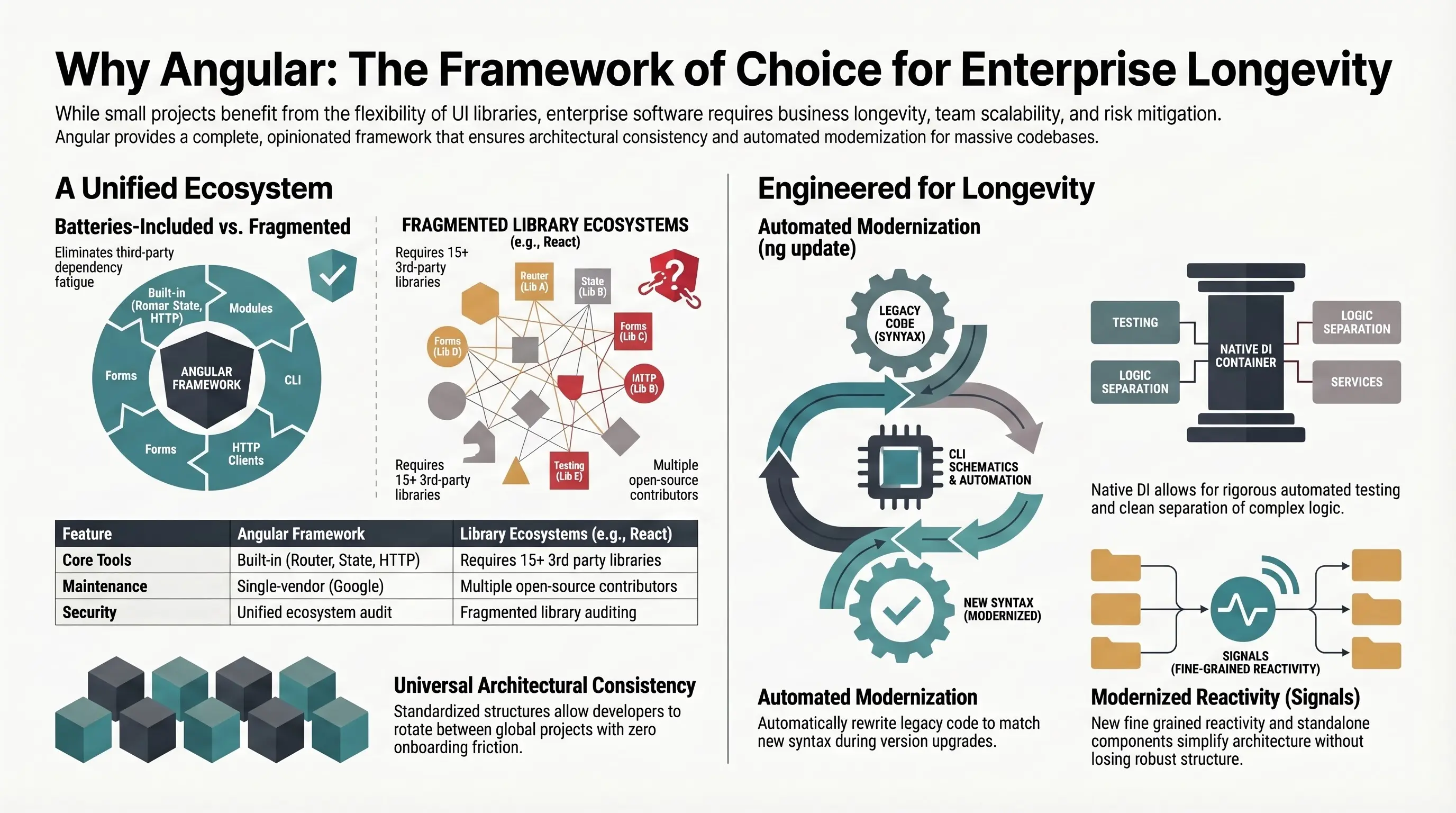
Angular's "batteries-included" philosophy eliminates decision fatigue. Out of the box, Angular provides a world-class Router, powerful Reactive Forms, the HttpClient module, and a robust state and reactivity model (RxJS + Signals).
This means enterprise teams spend less time arguing over third-party dependencies and more time delivering business value. It also means security teams only have to audit one ecosystem, not a patchwork of 15 different libraries maintained by random open-source contributors.
️ Architectural Consistency
In the enterprise world, developers rotate between teams and projects frequently. If every project uses a different stack of state managers and routers, onboarding is slow and painful.
Angular forces you into a specific, structured way of doing things. Whether you open a banking application in Berlin or an e-commerce dashboard in New York, an Angular codebase looks like an Angular codebase. You instantly know where the services, components, guards, and interceptors are.
Dependency Injection (DI)
True enterprise software requires complex business logic separation and rigorous automated testing. This is where Angular completely eclipses its competitors.
Angular brings native, hierarchical Dependency Injection to the frontend - a concept traditionally reserved for serious backend frameworks like Spring Boot or .NET.
import { Injectable, inject } from '@angular/core';
import { HttpClient } from '@angular/common/http';

@Injectable({
  providedIn: 'root'
})
export class PaymentService {
  private http = inject(HttpClient);

  processPayment(amount: number) {
    return this.http.post('/api/payments', { amount });
  }
}
Because dependencies are injected rather than hardcoded, you can easily swap out the actual HTTP service for a mock service during unit testing.
import { Component, inject } from '@angular/core';
import { PaymentService } from './payment.service';
@Component({
selector: 'app-checkout',
standalone: true,
template: `
`
})
export class CheckoutComponent {
// Service is injected easily, ready to be mocked in tests
private paymentService = inject(PaymentService);
checkout() {
this.paymentService.processPayment(100).subscribe();
}
}Long-term Stability and Predictability
Agile startups can afford to rewrite their applications every 3 years. Enterprises writing 2-million-line ERP systems absolutely cannot.
Angular is backed by Google and follows a strict, predictable 6-month release schedule. More
importantly, they provide the magical ng update CLI command. Angular provides
automated migration schematics that literally rewrite your legacy code to match new syntax
during major version upgrades.
Modernization: Signals and Standalone Components
Historically, Angular's learning curve was steep. But Angular has undergone a massive renaissance.
- Standalone Components: NgModules are optional, massively simplifying the architecture.
-
Signals: A new, fine-grained reactivity model that makes state management
incredibly intuitive and performant (goodbye
Zone.js!). - Esbuild / Vite: Extremely fast build times right out of the box.
Angular now combines the robust, safe architecture of enterprise software with the fast, modern developer experience of cutting-edge startups.
Conclusion
If you are building a small prototype or a simple blog, use whatever you like most.
But if you are building an application that will be maintained by 50+ developers, needs to survive for 10 years, and handles complex domain logic - you need rules, you need structure, and you need a framework that has your back. You need Angular.