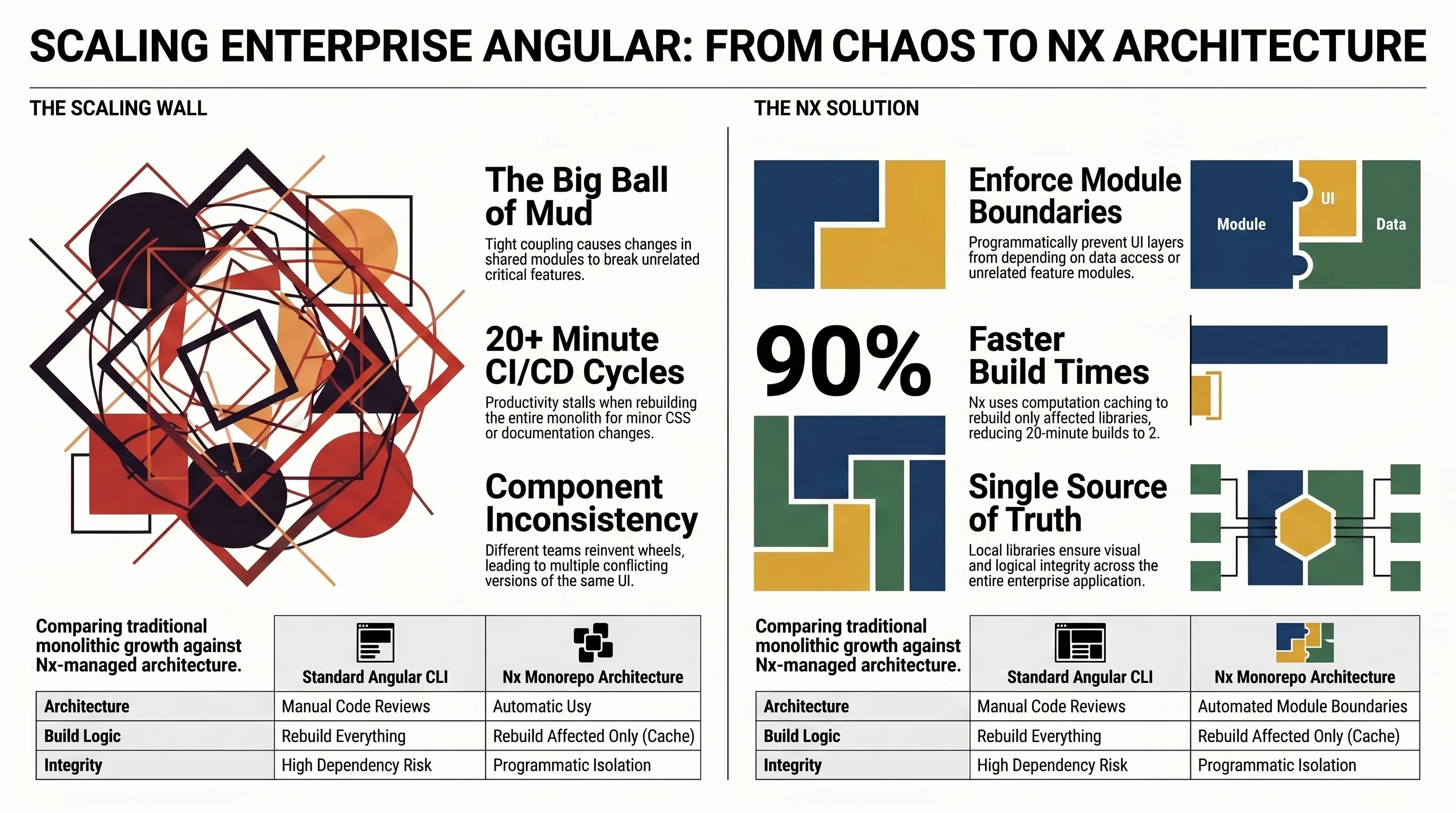
Many teams start an Angular project with the best intentions, following official documentation and standard CLI patterns. However, what works for an MVP often becomes unsustainable when the application grows to 50+ modules, 20+ developers, and hundreds of business rules.
At Pistackio, we have seen dozens of projects hit a wall. Here are the three main reasons why this happens and how a monorepo architecture (Nx) solves these problems before they become fatal.
1. "The Big Ball of Mud" (Lack of Boundaries)
The biggest enemy of scaling isn't technology, but tight coupling (excessive component interdependence). Without strictly defined boundaries, developers start importing services and components from random parts of the application.
- Problem: A change in the "shared" module can unexpectedly break the Checkout process because someone "borrowed" a function that doesn't belong there.
-
Nx Solution: By using the
Enforce Module Boundariesrules, we can programmatically prevent UI components from depending on the Data-Access layer or Feature A from knowing anything about Feature B. The architecture is maintained automatically, not just through Code Review.
2. Slow CI/CD Cycles (Time is Money)
When an application becomes huge, standard ng build and ng test become enemies of productivity. If your pipeline takes 20+ minutes, developers lose focus, and deployment becomes a stressful event.
- Problem: Rebuilding the entire monolith due to a change in a single CSS file.
- Nx Solution: Affected commands and Computation Caching. Nx understands your application's dependency graph. If you change code in the "Profile" library, Nx will only test and build that part and what directly depends on it. Everything else is pulled from the cache. The result? A build that takes 2 instead of 20 minutes.
3. "Dependency Hell" and Inconsistency
In large systems, different teams often start reinventing the wheel. You get three different DatePickers and five different ways of handling API errors.
- Problem: Maintaining visual and logical integrity becomes impossible, and upgrading the Angular version becomes a multi-month project.
- Nx Solution: Code sharing through local libraries within a monorepo. Instead of having 10 repositories, you have one true source of truth. An update to one library version reflects everywhere, keeping the entire system always fresh and aligned.
Conclusion: Scaling Requires Discipline, Not Just Code
Enterprise Angular is not just about writing components; it's about managing complexity. Without tools like Nx, your frontend will sooner or later become a burden instead of an engine for growth.
Is your team struggling with slow builds or "fragile" code?
At Pistackio, we help companies extract the maximum from Angular through advanced architectural audits and the implementation of scalable solutions.